
Puska is a traditional meat delicacy that was once typical of Central Southern Bulgaria, in the region between Parvomay and Haskovo. It consists of chopped pork stuffed into a pig’s bladder — the “puska.”
The name “puska” comes precisely from the old dialect word for bladder, which was used in the southern parts of Bulgaria. Today the word is rarely used, and its meaning is known mostly by older generations.
Some people compare puska to babek or Strandzha-style dyado, but the flavor is quite different, and puska is definitely one of the saltiest Bulgarian cured meats. The meat in puska is cut more coarsely — rather than minced, it is diced into cubes about 2–3 cm in size. There are several variations of puska; some add leek, others hot pepper. I added leek, and the final product turned out excellent.
Puska with Leek Recipe:
- Pork bladders for stuffing
- Pork from the shoulder and/or leg, plus pork belly and/or back fat. The fatty portion should be about 30% overall.
- Salt – 40 g per kg of meat
- Black pepper – 6 g / kg
- Cumin – 6 g / kg
- Finely chopped green part of leek only – about 40 g / kg
First, you need to obtain pork bladders; I bought mine from a supplier. Natural ones come dried and vary in size. For example, one held about 800 g of raw mixture, while another held around 1.3 kg. Larger ones can hold up to 2 kg. They are sold dried and folded into quarters, and you must soak them in lukewarm water for some time to soften before stuffing.

I have also seen artificial casings sold as puska, which hold about 600 g of meat and are designed to be tied and hung easily for drying. I haven’t tried them yet, but I plan to test them soon.
Chop or dice the meat into pieces about 2–3 cm in size. Measure the spices according to the amount of meat, mix everything thoroughly, and leave it to rest in the refrigerator for at least 24 hours.

Next comes stuffing the softened bladders (which you have already soaked in lukewarm water). You may use a funnel or simply stuff them by hand. At first, I used a funnel, but later I filled them entirely by hand. The important thing is to pack the meat very tightly so that no air pockets remain. To help compact and shape the filling, I used a wide wooden pestle from a mortar.
After filling the bladders well, sew the openings securely with needle and thread. The puska must also be pressed; it is best if the sewn side remains on the side so that any trapped air can escape during pressing. I press the puskas between two wooden cutting boards and place a weight on top (I use a large water container, but you can use anything convenient as a weight).

After being pressed for a day, the puska should be hung to dry. Since it is heavier than most other cured meats, it is good to tie it securely with twine and hang it in a suitable place for drying.

I dried the puskas for roughly three months while hanging, and afterward they rested for about another three months buried in wood ash. However, this turned out to be a bit too much, and they became overly dry, so they had to spend some time in the freezer (freezing dried meat slightly rehydrates and softens it).
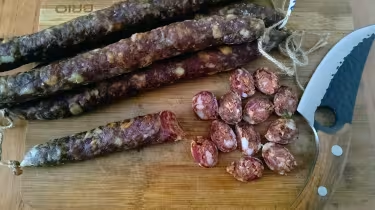
Both versions — the drier one and the one softened by freezing — were greatly appreciated by friends and acquaintances. They have an incredible and unique flavor! Here is what the final result looks like:



Add new comment